

Introducing COSMOS™
Merging CCD and CMOS performance
COSMOS™ will meet the increasing demand for higher performing sensor technology by combining the essential elements of both CCD and CMOS technology to create a new generation of devices that are distinctly different from anything currently available on the market. COSMOS is the optimal combination of resolution, pixel size, sensitivity, and speed. It is the only large format, high performance CMOS camera designed and manufactured entirely within a single source.
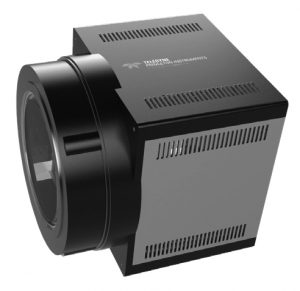
- 0.7 e- read noise for detection of faint objects
- Up to 8k x 8k sensor sizes for maximum field of view
- >90% peak quantum efficiency for high sensitivity
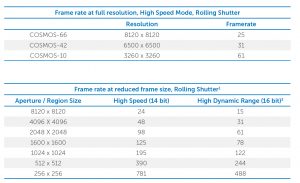
- High duty cycle and up to 50 fps for capturing dynamic events
- Large dynamic range to prevent sensor saturation
- Rolling and global shutter
Teledyne Imaging Heritage
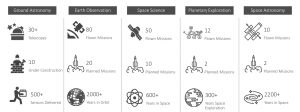
Built upon decades of detector design and fabrication, Teledyne Imaging has provided solutions for a wide range of world changing projects, such as the Mars Rover missions,been implemented on multiple observatory instruments, such as the European Southern Observatory Very Large Telescope MICADO, HARMONI, METIS, and MUSE, and involved in multiple surveys, such as the Javalambre Physics of the Accelerating Universe Astrophysical Survey. Teledyne Imaging’s sensors, cameras, and imaging systems can address virtually any imaging requirement for airborne, space, defence, or security applications..
LACera Technology
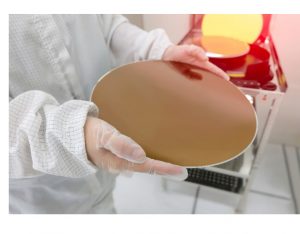
LACera™ represents the dawning of a new ear in CMOS technology, exclusively developed and owned by Teledyne Imaging. LACera is a monumental step forward in CMOS capabilities for advanced imaging, enabling the next generation of discovery. The challenge of CMOS sensors has been maintaining performance when scaling to larger formants.
LACera combines high speed and low noise architecture, while delivering deep-cooled, low-noise performance on a multi-megapixel scale with global shutter, 18-bit readout, and glow reduction
technology.
LACera represents a critical element of advanced imaging solutions and is only possible with the
nature and scale of Teledyne. From pixel, sensor,and ROIC design, through low noise electronics, to
deep cooling, and system interface, Teledyne is the only company capable of delivering this one hundred
percent organic solution in large-format CMOS
COSMOS: Harnessing LACera™ Technology
Utilizing the powerful technology of LACera™, COSMOS also combines low-noise electronics and novel sensor cooling and packaging to deliver unprecedented performance.Typical CMOS limitations, such as “glow”, limited dynamic range, and compromised global shutter, have also been improved to provide a turnkey product that answers the demands of many applications
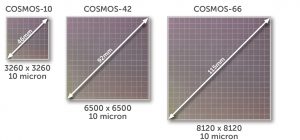
Specifications
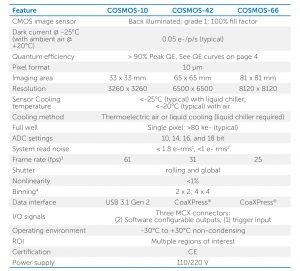
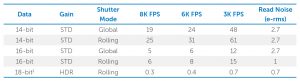
Specifications are preliminary and subject to change. Certification CE
1. Rolling shutter and high gain. Global shutter and high gain < 3 e- rms
2. With Correlated Multiple sampling and high gain
3. Frame rates stated with rolling shutter, non-HDR, and 14 bit digitization
4. FPGA binning
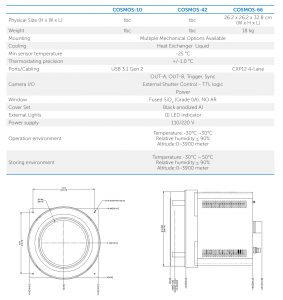
Mechancial and Electrical Specifications
Key Features:
- Unbeatable Sensitivity
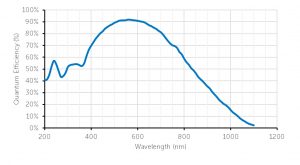
COSMOS achieves near-perfect light collection thanks to back-illumination, with quantum efficiency peaking at over 90%. What’s more, with minimal 0.7e- read noise and 0.05e-/p/s dark current, the COSMOS surpasses both CCD and EMCCD technology in its ability to detect weak signals
- Multiple Readout Modes
- Dynamic range
The combined HDR signal in COSMOS is the merged result of two 16-bit measurements
onto a larger 18-bit range. By combining the low read noise, along with the intrinsically low
noise of the analog to digital converters (ADC), COSMOS enables accurate measurement
of weaker signals and unlocks wider dynamic range. However, the dynamic range is still
bounded by the read noise floor in high gain and the FWC in low gain. As such, the COSMOS
has a dynamic range of 80,000 e-/0.7 e-rms, which is equivalent to 114,286 discrete levels - Shot Noise Limited HDRIt is common practice in sCMOS sensors to enhance dynamic range by combining 2 or
even 3 conversion gains within a single CMOS pixel. This imaging modality is commonly
referred to as High Dynamic Range or HDR. To understand how dynamic range is enhanced
in HDR readout modes, one must first consider how read noise and full well capacity are
affected by changing gain and how the final photon transfer curve (PTC) is established
- HDR Readout Mode
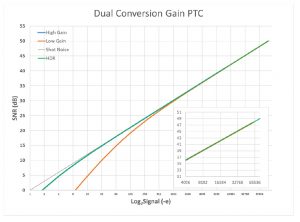
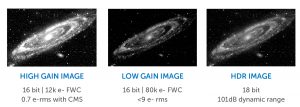
Our proprietary 18-bit HDR mode utilizes dual conversion gain to increase Full Well Capacity (FWC) while maintaining ultra-low noise performance. In HDR mode, each pixel is sampled twice –once with high gain and once with low gain conversion. High gain readout provides ultra-low temporal noise needed for sampling low light signals with reduced FWC. Low gain readout provides higher FWC for sampling intense signals dominated by photon shot noise where low temporal noise is less critical. Both these gain mode readouts are combined into a single image preserving the best of both worlds –
ultra-low noise and high FWC providing exception dynamic range
- Shutter Modes
CMOS sensor technology takes advantage of electronic shutters, removing the error, maintenance, and speed limitation associated with physical mechanical shutters. Although typically CMOS technology only provides rolling shutter modes, COSMOS implements both rolling and global shutter modes
- Fast Frame Rates